
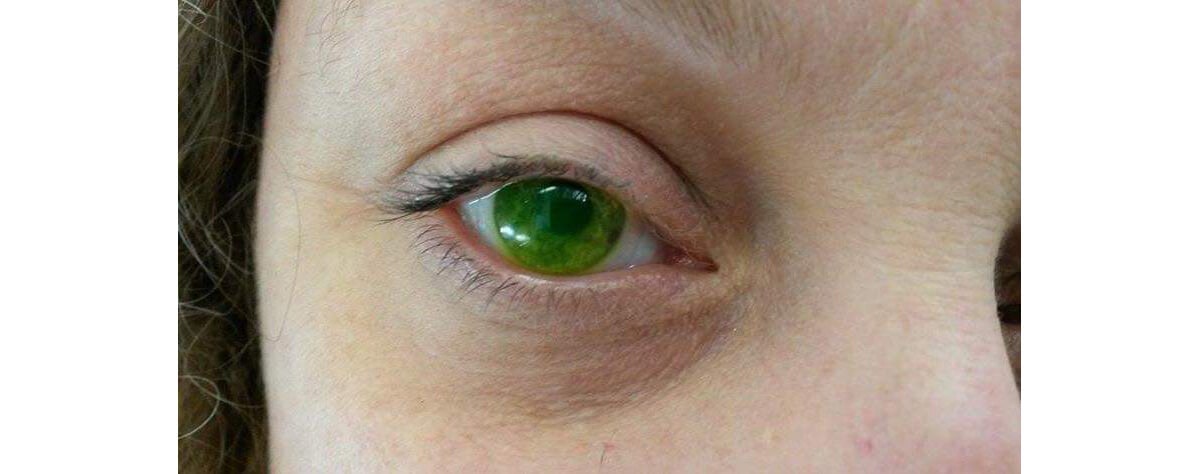
I’m not very sure what I’m supposed to be doing in the last few days before my corneal transplant…
Preparations
I’ve tidied up a fair bit, cleaned, hoovered and dusted round the edges. It looks good to me! I’ve got some food prepared in the freezer, which Malcolm thought was hilarious as that’s what he’s for! I’ve hung hooks by my blinds (in case I’m light sensitive and need to hang a sheet over the window). I dyed my hair (not successful at all, think ‘yellow’) and hung out the last of my washing, including hospital dressing gown and pyjamas. I’ve bought everything I can think I might need that I don’t already have (saline/ cotton pads/ safety goggles). I’ve started another shopping list (forgot about hankies), downloaded a podcast app on my phone (actually need to work out how to use it!) and got yet another list for packing my hospital bag!
I had decided to write down what my life/ lack of/ vision is like just now, ‘before’ my operation to remind myself ‘after’, in case it all goes horribly wrong and I wish I’d never decided to go ahead…
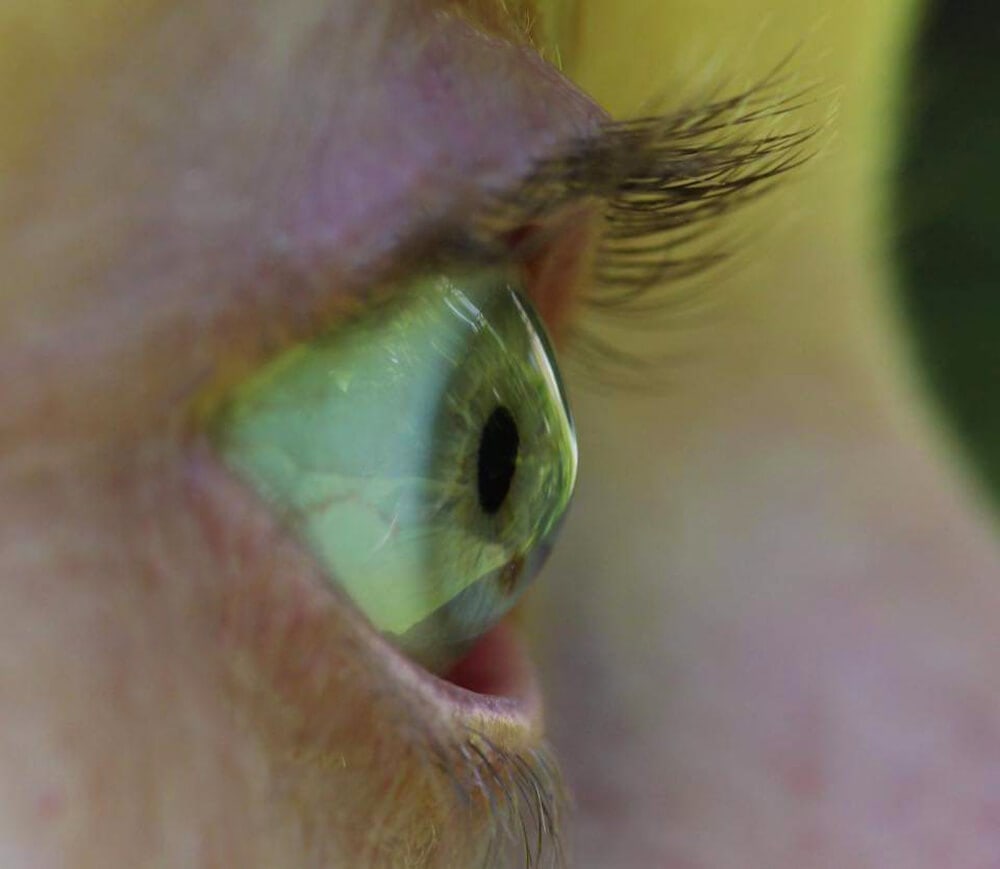
Profile of my right eye with keratoconus (the cornea to be transplanted). It should be a lovely gentle curve, it’ll be interesting to see if I can get a photo for comparison post-transplant!
Diagnosis
Diagnosed with keratoconus in 1999, aged 28, it was not long after Ronan and I moved to Dumfries, in the year following my brain surgery to remove a haemangioblastoma tumour (long story short, I survived!). I was with a new optician who thought he knew why it was difficult to fit me with contact lenses. (There is no longer a branch in the town, but I will be eternally grateful). He sent me off to the local hospital, who confirmed that it was keratoconus.
Keratoconus
Keratoconus (kc) is an eye condition in which the cornea thins. This creates an uneven, cone-shaped ‘window’ to the world, instead of a lovely smooth round window. This ‘irregular astigmatism’ is caused by the corneal deformation and it can’t be corrected with glasses. Hard contact lenses are needed to recreate a regular, smooth surface.
The trouble with keratoconus
Without lenses, vision is blurry and distorted. I see multiple images superimposed (almost) on top of each other. In a ‘normal’ eye, the light rays all enter the cornea and merge in a perfect spot on the retina. A kc cornea causes the rays of light to hit the cornea in different places, thus the brain reporting multiple images.
- ‘The moon’ is actually ‘the moons’, I can’t actually count how many there are anymore, they all form an additional circular mishmash of light trails
- It makes drawing difficult. Which edge is the real edge? Which pencil point is the one I’m actually using?
- And driving is impossible
- My worst scenario of all is recognising people. I can’t. And so, it makes social situations (or just leaving the house) an anxiety ridden escapade.
- We can be on the tandem, and Malcolm will say, ‘Ooo, here comes…’ [he is notoriously awful with names] so I smile and wave anyway. We can then spend the next few miles trying to work out who it was. Sometimes it’s easier when he just shouts “WAVE”!
- I remember a time, not too long after I had to be off work, when 2 wee boys came running up to me in Tesco shouting “Miss Baxter, Miss Baxter”… I just couldn’t see to recognise them. It was a truly awful moment of panic, and it wasn’t until they were right beside me that I worked out who they were. The memory of that experience has made going out locally, without my lenses increasingly difficult.
- You can maybe appreciate how difficult supermarkets are anyway. The bright, artificial lighting and aisles and aisles of brightly coloured repetitive kaleidoscope patterns. It can be difficult enough to locate the right aisle, never mind the right product. And at times, checking the items can mean sticking my nose right up to the shelves. It takes the ‘sniff test’ to a whole new level! I have come home with the wrong things before now. Some packets are more easily recognisable than others however, until the branding is changed!
This multiple image phenomena is called ‘ghosting’ and the novelty wears off pretty quickly when you realise there isn’t an ‘off’ switch.
I have had days when the thought of having to take my lenses out after a few hours ‘normality’ is so depressing, that I haven’t put them in at all. There is a dreadful vulnerability about it all. A disadvantage. Everyone else can see clearly, focussed, details. I can’t. It is easier to stay inside away from other people, where I know what’s where and my brain doesn’t have to work overtime trying to work it all out.
It isn’t me. I’m not dis-abled. I don’t want to be less able or to stand out for being different. Reduced. Diminished. I am capable and confident and independent, still. I haven’t changed, I just can’t wear my lenses. But without them, I am entirely dependent and incapable and have no confidence at all.
You can’t tell by looking, but I know. I can feel terribly alone in my wee kc blurry bubble. My brain can’t function at full capacity as such a lot of it is trying to work out what I can’t see. I can’t think as well as I can. Font size ‘largest’. Impatient cashiers raise an eyebrow instead of saying ‘next’ – really, you expect me to notice?
And there’s more…
Along with the ghosting, there is haloing, which describes the ‘special effects’ lights and light sources have. Rather than a vague halo, I see huge antler rays or spider web traces coming from light sources – all light sources. Again, it can make e.g. a Christmas tree look ‘pretty’, but I’d far rather see lights normally, thank you very much.
Car lights, traffic lights, street lights, light from windows, light through doors, disco lights, fairy lights, night lights, screen lights, keyboard lights, all lights don’t look like lights.
It is frustrating that most eye charts are lit from behind. This interferes even more with the deciphering of the letters. And it is a deciphering game. ‘Reading’ wouldn’t be an accurate description of what I do. Though I am very good at deciphering, being an infant primary teacher, I still can’t read the top (biggest) letter on the Snellen chart without my lenses in. Hieroglyphics come closer to what I see. At one hospital appointment, my skills really were put to the test as the chart given was meant to be read directly from a distance, not reflected in a mirror – so not only was I struggling to work out what the top letter was, I was trying to read a backwards letter too…
I used to suffer greatly from photophobia – bright days, bright lights and even reflected light were extremely painful. Since I stopped wearing rgp (rigid gas permeable) lenses, the one benefit has been the lack of light sensitivity. Silver linings!
Seeing Aids
I first got glasses in primary 7 after my mum noticed I was holding my head at a funny angle, trying to thread a needle. Uncommonly, I was long sighted. The routine school eye tests only tested for short sightedness. My glasses were the highly unfashionable (at the time) brown NHS specs. My brother chose black ones. I think I had the girlier options of pale blue or pink, but I was never that girly.
At the age of 14, I decided that I wanted contact lenses for my birthday, to replace my glasses. I will never forget the moment I looked out the optician’s window and clearly saw the daisies in the grass for the first time, the individual leaves on the trees and the nauseating/ kaleidoscopic sensation of seeing the pavement’s mix of different coloured stones.
Nowadays, more opticians are aware of keratoconus, and more children and teenagers are being diagnosed. I suspect I had kc back then, and these rigid gas permeable (rgp) lenses made my cornea the right shape to focus through.
You’ll be pleased to hear that I haven’t driven for a number of years, but I passed my test way back when I was 17, and my motorbike test at 21. Both times, I was anxious about reading the number plates, so my corrected vision was obviously an ‘issue’ for me then, I just didn’t know more about it.

A triptych of my foggy scleral lenses, smearing can be a problem, or tears not adhering to the material. Imagine trying to see through this…
Nowadays, there’s a procedure – corneal cross linking (cxl) which strenghtens the collagen in the cornea, preventing progression in kc eyes. It has to be done in the early stages, whilst the kc is still progressing. (My corneas are too thin, the kc is too advanced.) My surgeon used to do several transplants a week, now he’s averaging just one a week! This is brilliant news. Maybe advanced kc will be a thing of the past!
Back to the chronology:
The hospital in Dumfries sent me to another (independent) optician, Glen Barr Opticians for contact lens fitting. Colin Barr was fantastic and fitted my rgp lenses for the next 12 years when many opticians don’t even touch rgps anymore.
After that, when fittings got too tricky, Colin referred me to the eye hospital in Glasgow where there is a dedicated contact lens department. My friend Kate drove me up there for my first appointments and waited around the crowded waiting rooms as I had various eye tests and checks done. One doctor told me then that I might need to have special rings inserted into my eyes. The thought terrified me…
To cut a long story short, they fitted my lenses for the next few years, I rarely went to the general eye department. The specialist contact lens department was much smaller and friendlier. They were very understanding and supportive, especially if I was asked to go without my lenses for weeks before a topography etc. (The topography gives a detailed description (in pictures and figures) of the curvature and shape of the cornea. This shows progression and changes and is helpful in fitting lenses, and informing surgeries).
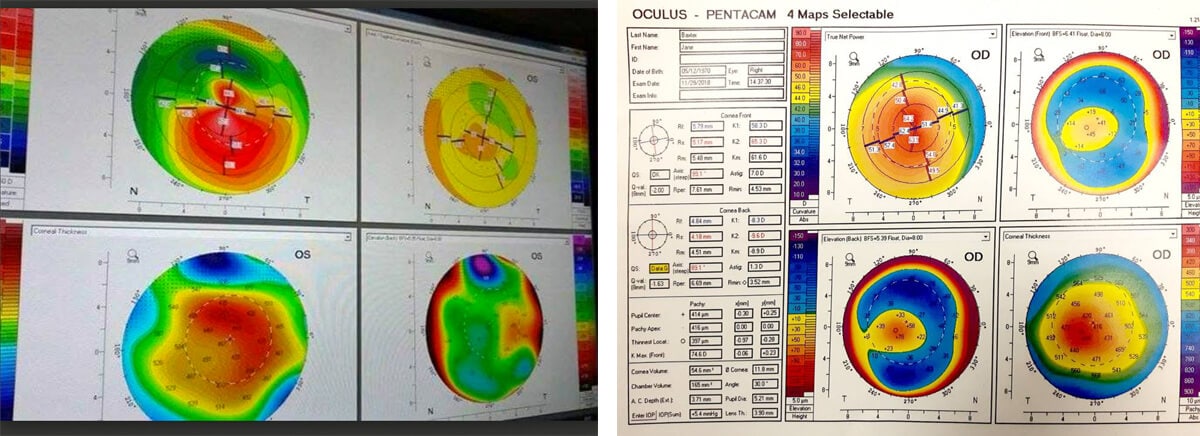
Two of my topography charts
Work and Vision
On Tuesday March the 24th 2015, I went into work with very sore eyes. They had been hurting for quite a while, but I had to mark work, plan lessons, make up worksheets, create fun and fantastic homework activities etc. etc., and I needed my lenses in to do that. I persevered with wearing them so I wouldn’t miss work…
I remember having to close the blinds in the classroom because even the reflected light on the desks was too bright for my eyes. I couldn’t use the Promethean board because it was too sore to see. My eyes were streaming and very painful. I remember telling my headteacher first thing that morning that my eyes were sore and I’d have to see how I got on. I managed half way through the writing lesson, and I had to let the learning support assistant know that I had to go and take my lenses out. I phoned Malcolm who came to drive me home.
That morning was the last time I’ve driven in over 4 years.
Trial and Error
Thus ensued many more visits to Glasgow. I tried lens after lens – softies, toric, hybrid, mini scleral – several different ones of each. Until the contact lens dept came to the end of their experience and expertise. I was referred to the surgeon who wanted to give me a corneal transplant.
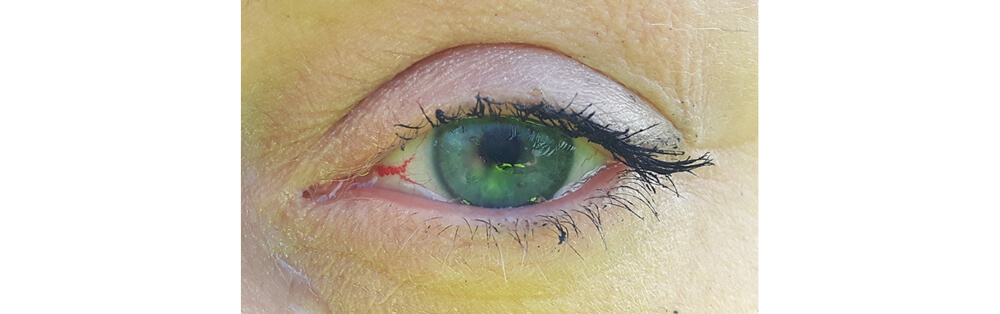
Photo of my left eye wearing a fogged up (smeary) scleral lens…
I had been a member of several online groups and knew that a transplant should be the last option, after all lens options had been exhausted. I took some advice and spent the next 6 months arranging a 2nd opinion in Edinburgh. During this time, my transplant date came up at Gartnaval. It was to be the day before Ronan’s graduation, not to be missed! However they were understanding that I was seeking a 2nd opinion to try to avoid a transplant, and the date was postponed.
Cameron Optometry is a private optician in Edinburgh who see complex cases on the NHS referred from the The Princess Alexandra Eye Pavillion (the city’s eye hospital). They are very highly regarded, hugely experienced and have won awards for their work.
My corneal surgeon at the Eye Pavillion agreed that I should see the opticians at Cameron Optometry to see what they could do. I was delighted!
Contact Lens Technology
Cameron Optometry have an amazing array of advanced technology, and one of their specialised machines showed that the large scleral lenses I was wearing were actually touching my cornea. They’re meant to sit on the white of your eye with a layer of saline solution cushioning the cornea, vaulting over its nerve-rich surface.
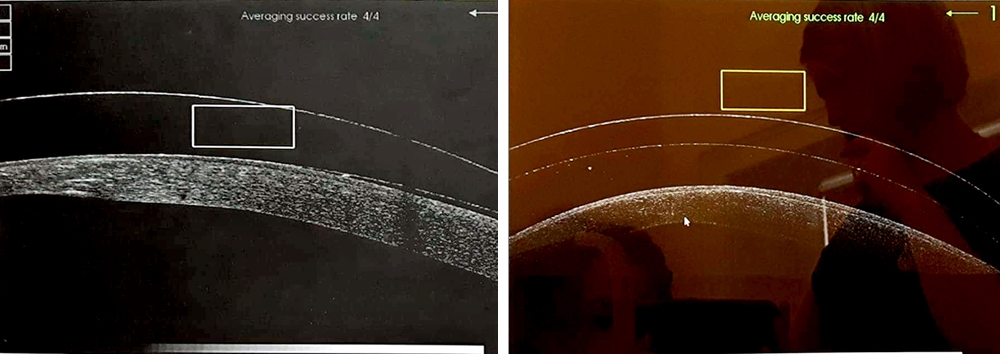
Photos showing the light-wave scans of my cornea with poorly fit lenses [left] and well fit lenses [right]. Ignore the rectangles. The large area of ‘interference’ is my cornea, showing its thickness (or lack there-of) and scarring, on the right you can see a gap between my cornea and the lens (the outer 2 curves show the depth of my lens). This is the saline-filled ‘cushion’, which is completely missing in my previous lens which you can see squashed right against my cornea [left]. Ouch.
I had a(nother) new pair of sclerals custom made, but even with the better fit, my visual distortions weren’t sufficiently corrected, and the lenses kept ‘fogging up’. My tears weren’t adhering to the surface of the lens but evaporating off. After many attempts with different sclerals, solutions and drops it was decided that the necessary (and desirable) gap between my cornea and the lens was enough to refract and scatter the light. I needed a contact lens that would sit directly on my cornea.
So, back to rgps, this time cushioned from my cornea with a soft bandage lens. Whilst my wear-time has increased from 1 or 2 hours to 4 hours maximum a day, and we have tried many different types, sizes, prescriptions, solutions, drops and materials of rgp lens, I just can’t wear them for longer.
Corneal Transplant Journey
It has been a long struggle. Some folk call it a journey. 4 years of trying, of ups and downs, hopes and disappointments, loss of independence, confidence and identity. In November 2018 I had had enough. There are no other lens options available. We have tried everything. The search has been exhaustive and exhausting.
Keratoconus – what it feels like
It can feel nauseating, the sensation of seeing everything in multiple. It can be draining, always trying to focus, but not being able to. I have huge, etched frown lines from the years of strain. I look permanently angry, aged before my time. Life has become pretty small. Within the safety (confines) of my house and garden. Or Malcolm’s. Or the camper van. Driving along, I have to look away, as the white lines veer off into the sky.
It can hurt my poor brain, this striving to see.
I’ve learned to soft focus. To just let things be.
I’ve stopped going out, afraid to feel lost.
I stay in the house, but what is the cost?
I’ve felt helpless and hopeless, without purpose, with fear.
The only thing for it’s a bath and a beer!
Support
And through it all, I have been completely indebted to Malcolm. He has driven me everywhere, gone shopping for me, seen me over roads, tried to remember who people are in time, humoured me, stood by me, accompanied me to appointments and to the toilet (not actually in there, but to show me which is which – yes, I have walked into the mens’… [Please make the signs bigger and clearer. The ‘funny’ ones aren’t really funny if you can’t make out if they are men or women.]
He has also taken notes for me, driven half way across the country to buy a second tandem (we now have Bruce I and Bruce II), taken me to appointment after appointment, pedalled me up hills and through rivers (oh yes, I haven’t forgotten…), held my lens case on street corners so I can take my lenses out and held my hand along the way.
He has read out menus, road signs, instructions and subtitles, described the scenery, made bad jokes and been there every step of the way, without fail and without (audible) grumble. He incidentally also didn’t flinch when I told him I might be unbearable after my transplant. Or at least if he did, I didn’t see it!
I have to mention how good my work have been about it all too. I am on an official career break as the best option available. We’ll just have to see how it all goes.
And the kc and Corneal Transplant Support groups online. I have learned so much from other people and their experiences.
Back in 1999, I didn’t have the Internet, my friend looked up a book. It said keratoconus was progressive, I thought this meant it got better!
The Date!
So, Friday 21st June 2019 is my big day. The one I’ve been eschewing these past 4 years.
I have been telling my eye about it all. Visualising what will happen in preparation. Willing a warm welcome to this new part of me…that was a part of someone else. My body sometimes decides that internal fighting is the order of the day – several (comparatively minor) auto-immune issues need banished from my mind. Corneal transplants are the most successful transplant operation as there is no blood supply to the cornea. Rejections can be and have been reversed. It might not even happen.
Progress
It was only fairly recently that I actually considered the fact that this could, in fact, be a success!
And from that moment of optomism, I have ‘focused’ on the potential benefits, the good outcome, the belief that this is right. It certainly feels better than ‘giving in’ to fear, ruminating and worrying. Indeed, quite probably the best thing I’ve learned!
I wonder about the donor. Who they were, how old were they, man or woman, what happened, what were they like, would we have got on, what have they seen?
The fact that someone else’s family is suffering a loss while I have this opportunity to see, because of them, is a constant reminder that others have given, through grief, in thought and in genuine kindness.
It is a responsibility for me to do my best to welcome this cornea, and to make the very most of it all.
I’ll keep you posted.

